






















A common sight in a visit to the Beaverdam Reservoir Park in Ashburn, Va., during the early evening or on a springtime Saturday morning, will be a few rowing boats – or shells – on the water, crewed by several scholastic rowing teams. The 300-acre reservoir has been a popular place for crew teams to practice.
A part of the project that created the park, a dedicated boathouse was constructed to provide shell storage and facilities for the athletes. Designed by Studio Twenty Seven Architecture of Washington, D.C., the building is reminiscent of a lantern. Integrated into the building’s design are eight Schweiss Doors liftstrap bifold doors, measuring 12 feet, 2-1/2 inches by 9 feet, 3 inches.
“During the day, you go inside and you kind of get the sense of the light filtering through the building,” says Bethan Llewellyn-Yen, lead architect at Studio Twenty Seven Architecture. “At nighttime, when you’re outside and the doors are closed, it all kind of glows.”

Studio Twenty Seven wanted the boathouse to match the overall look, feel and aim for the entire park. The Beaverdam reservoir is a man-made body of water, created by damming a portion of the Beaverdam Creek to provide drinking water for the surrounding communities. The reservoir and surrounding land became a popular place to fish, row, hike and just escape to nature in the highly built-up area surrounding Washington D.C.
The project at the reservoir created a new park with upgraded amenities while also working to protect the natural environment and water quality of the reservoir. The project was a partnership between Loudoun Water, which owns the reservoir, and the Northern Virginia Regional Park Authority (NOVA Parks), which operates parks and recreational facilities across northern Virginia. Nelson Byrd Woltz Landscape Architects was chosen as the designer of the overall park. That firm hired Studio Twenty Seven to help with the design of the structures.
“We took to heart this idea of promoting civic infrastructure and water source protection,” Llewellyn-Yen says. “Water was the prime client and we wanted our buildings to showcase the importance of protecting the water source. Every building in the design looks to capture every rain drop and from there directly to the reservoir.”
The welcome center and picnic pavilions all have V-shaped roofs that collect rainwater, direct it off the roof and into a rain basin on the ground. The basins are designed to hold the water temporarily before allowing it to slow drain toward the reservoir. The landscape was created to function as a living water filter, grabbing sediments and pollutants from the water. This helps keep the water in the reservoir clean.
The park also includes upgraded trails and docks. Throughout the park there are educational signs, boards and medallions explaining how the buildings and landscape work to protect and conserve water and the environment.
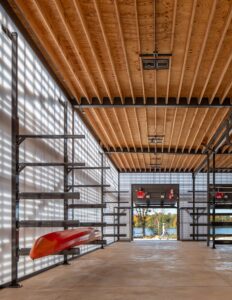
While the crew facility has less of a direct role in the environmental protection side of the park’s mandate, it was still designed to fit into the larger picture. Instead of water, it filters people and boats through its structure and onto the boat docks and forward into the reservoir itself. The exterior of the building is clad in a thermal spruce wood siding and the interior is covered in a polycarbonate product that is translucent enough to allow light to filter through it. The wood cladding isn’t tightly installed but instead leaves faps between each slat. This created a skin on the building that mimics a paper lantern, or a drying barn used to dry and preserve crops.
Providing access in and out of the building are the eight Schweiss bifold doors, four on each side of the building. The doors were engineered to hold the polycarbonate and wood cladding and include side-latch switches, electric photo eye sensors and emergency back-up hand cranks.
Llewellyn-Yen says they wanted a door that could be customized to work with the vision of the building and have minimal impact on the interior of the boathouse. Inside there are shelves to store over 60 rowing shells and it requires open space to be able to maneuver the shells in and out.
“The capability of the Schweiss Doors bifold doors folding outward was critical, so that it didn’t interfere with the space we were trying to get in the building to house as many crew teams as possible,” Llewellyn-Yen says.
As is fitting for a project that includes amenities for a sport that is all about people rowing together as one, teamwork was an important piece of making the park project a success. This includes Schweiss Doors, which worked closely with Studio Twenty Seven and Meridian Construction Company, the general contractor for the Beaverdam Reservoir Park project.

“The Schweiss Doors team was awesome,” Llewellyn-Yen says. “They worked with us through construction and looking at the different options and the different ways we could customize.”
Approximately six school rowing teams use Beaverdam Reservoir as their practice home and store their shells in the park’s crew facility from about February through May. Having the boats in the building and rowers using the facility are the finishing touches of the building’s design.
“We are really happy with how it all worked out,” Llewellyn-Yen says. “We’re excited to see the teams really use the building. Now that all of the boats are in there and the teams are in there, the palette of the building and everything has come together.”
About Schweiss Doors
Schweiss Doors is the premier manufacturer of hydraulic and bifold liftstrap doors. Doors are custom made to any size for any type of new or existing building for architects and builders determined to do amazing things with their buildings, including the doors. Schweiss also offers a cable to liftstrap conversion package.